testglobe
| Website | Repository | WebGL |
testglobe displays a 3D globe through different graphics APIs and hardware, with an emphasis on systems from the late 1980s and early 1990s. It compares detail from flat-shaded polygons with detail from texture mapping: flat shading assigns each triangle or quad an Earth-map color, while texturing samples the map across it. Texture mapping starts disabled. Higher resolutions use more memory and rendering time.
OpenGL is the original backend. The additional backends and subsequent changes include AI-generated code. The experimental native backends have host regression coverage; native validation remains pending. See Testing and validation for the distinction between host checks and native rendering.
Browser version: live WebGL demo.
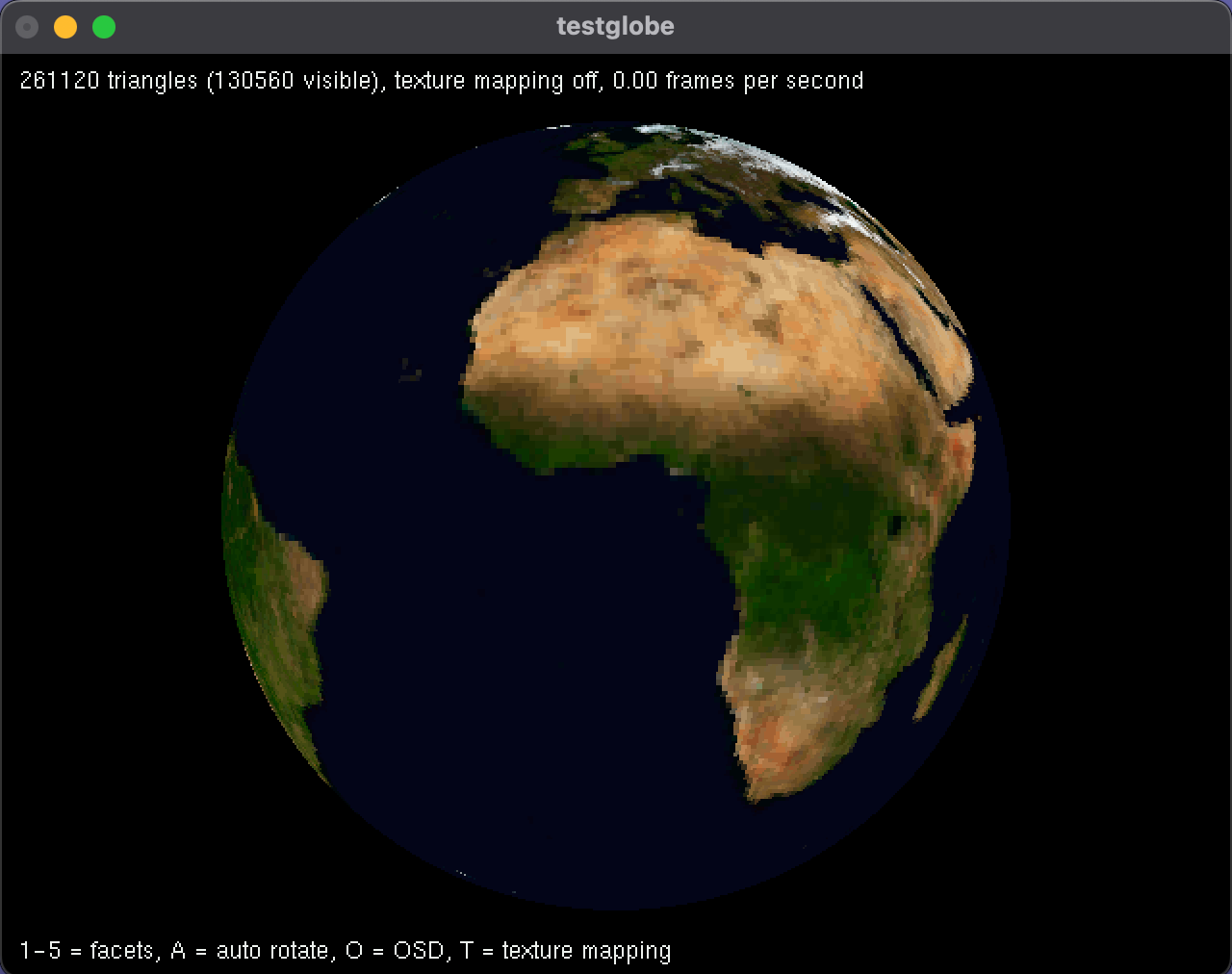
OpenGL driver running on macOS
Video: testglobe on a Sun Ultra 60 with Elite3D-m6 graphics
Contents
- Current drivers
- Controls and status
- Binary releases
- Build instructions
- Testing and validation
- Development notes
- Planned work
- Version history
- License
Current drivers
Earth maps store 8-bit palette indices. OpenGL and IRIS GL use those indices in either RGB(A) or color-index windows; Sun XGL expands them to RGB. Matrox LibShell, Windows GDI, and QuickDraw draw through the Earth palette. The browser frontend uses WebGL 2 with the same maps and palette.
| Driver | Platform | Default globe | Texture toggle |
|---|---|---|---|
| WebGL | Modern browsers with WebGL 2 | Key 5: 512 × 256 | Yes |
| OpenGL | Linux, Unix and modern macOS | Key 5: 512 × 256 | Yes |
| IRIS GL | IRIX 4.0, 32-bit MIPS | Key 3: 128 × 64 | Yes |
| Sun XGL | Solaris 2.6, 32-bit SPARC | Key 3: 128 × 64 | Yes |
| Matrox LibShell | MS-DOS, PG-641-compatible hardware | Key 1: 32 × 16 | No |
| Windows GDI | Windows 3.1, 16-bit | Key 1: 32 × 16 | No |
| QuickDraw | Classic Macintosh System 7, 68000 | Key 1: 32 × 16 | No |
Controls and status
Letter controls accept either case.
| Input | Action |
|---|---|
1–5 |
Select globe resolution; Matrox LibShell supports only 1 and 2. |
| Left mouse drag | Rotate the globe; the WebGL frontend also supports touch dragging. |
a |
Toggle automatic rotation. |
f |
Toggle FPS measurement and its on-screen statistic. |
o |
Toggle the on-screen display (OSD). |
t |
Toggle texture mapping in OpenGL, IRIS GL, Sun XGL, and WebGL. |
d |
Toggle display lists in OpenGL; enabled by default. |
Esc |
Exit native applications; in WebGL, pause rotation and release dragging. |
WebGL also provides on-screen controls and a Reset view button. Its retained GPU
buffers replace display lists; the d control applies only to native OpenGL.
Keys 1–5 select maps 32, 64, 128, 256, and 512 pixels wide (EARTH_32 through
EARTH_512); map height is half the width. The OSD counts quad patches for Matrox,
GDI, and QuickDraw, and triangles for the other drivers. Pole patches count as quads
even when coincident vertices collapse to a triangle for drawing.
Console builds print the globe resolution, vertex count, and triangle or quad count after each successful mesh construction. Failed attempts and selecting the current resolution do not repeat these messages. GDI and QuickDraw use their native OSD.
Matrox, GDI, and QuickDraw also report polygons retained after software culling. The other drivers report totals because native culling supplies no visibility count. FPS starts enabled; turning it off leaves rotation timing active. FPS measures the interval between completed presentations, including event-loop waits. It is an interactive frame rate, not a synchronized GPU throughput benchmark; native swap and flush calls provide different completion guarantees. Scene and rendering-mode changes restart the sample.
| Status | Meaning |
|---|---|
texture on |
The frame uses the graphics API’s texturing path; this does not guarantee hardware acceleration. |
texture soft |
OpenGL or IRIS GL uses the application’s software texture rasterizer. |
texture off |
Texture mapping is disabled. |
texture loading |
WebGL is fetching or uploading a texture; flat colors remain visible. |
texture fail |
Texturing is enabled but a detected failure prevents its use; recoverable failures draw flat colors. |
dlist on |
OpenGL successfully uses a display list for the current frame. |
dlist off |
Display lists are disabled. |
dlist fail |
Lists are enabled but unavailable, failed, or bypassed. |
GWorld on / GWorld off |
QuickDraw is drawing through an offscreen GWorld / directly to the window. |
Toggle t off and on to retry after a recoverable texture failure. OpenGL software
texturing bypasses display lists, so enabled lists report dlist fail on that path.
XGL’s internal software pipeline still reports texture on; IRIS GL cannot detect
all silent native texture failures. Their driver sections describe these limits.
OpenGL places dlist after FPS and before texture status, with its d help last.
QuickDraw appends GWorld status after the other statistics.
When a smaller texture is active, its width follows the status, for example
texture on (128) or texture soft (128). GDI reports direct drawing, individual
polygons, reduced colors, or manual rotation when those fallbacks are active.
On displays of 640 × 480 or smaller, GDI and QuickDraw default to a 320 × 240 client area; larger displays use 640 × 480. Explicit size requests are preserved, with QuickDraw clamping its window to the selected screen.
Resource recovery
Native backends do not rebuild the mesh when its current resolution is selected. When a new mesh cannot be allocated, optional rendering caches are released before retrying. The application can restore the previous resolution or select a smaller supported level; startup uses the same lower-resolution fallback. The OSD identifies the active result and any recovery notice. A scene that still cannot be built leaves a responsive empty window so another resolution can be selected. Bad data and invalid requests remain distinct from insufficient memory.
Insufficient texture memory or a queried native size limit can reduce the image from
512 through 256, 128, 64, and 32 pixels wide. Other native errors are not assumed to
be memory shortages. If no usable texture can be created, the request remains enabled
while flat colors are drawn and texture fail is reported. Geometry caches and large
submission packets are optional: direct drawing or smaller packets preserve the same globe.
Fallback resolution, texture size, buffering, and cache use affect performance, so
compare runs using the actual reported settings.
These fallbacks preserve usable native rendering resources. Selecting another valid resource can recover from bad map data, but does not repair the damaged resource. A lost device or an opaque native-library error can still require shutdown.
Binary releases
The v0.1 release provides OpenGL binaries for these platforms:
| Operating system | Architecture |
|---|---|
| IRIX | MIPS IV |
| Linux | ARM64 |
| macOS | x86-64 / ARM64 |
| Solaris | SPARCv8 |
Build instructions
The WebGL frontend runs without a native build. The portable Makefiles use
plain macro assignments and explicit rules shared by traditional Unix/System V make,
IRIX/Solaris make, and Microsoft NMAKE. GNU make is not required. Run the following
commands from the repository root or src, with the appropriate platform’s compiler
and libraries installed:
| Target | Command | Output |
|---|---|---|
| OpenGL (default) | make or make opengl |
testglobe-opengl |
| Solaris OpenGL | make solaris-opengl |
testglobe-opengl |
| Apple OpenGL | make apple-opengl |
testglobe-opengl |
| IRIS GL | make irisgl |
testglobe-irisgl |
| Sun XGL | make xgl |
testglobe-xgl |
| Matrox LibShell | nmake matrox |
testglob.exe |
| Windows GDI | nmake gdi |
testglob.exe |
| QuickDraw (MPW bridge) | make quickdraw |
TestglobeQD |
Native MPW users build QuickDraw with Makefile.mpw as described in its section. The
portable quickdraw target requires a configured bridge to the MPW tools.
Common build settings
Objects and executables are written in the directory where make runs. For an out-of-tree build, create a build directory, enter it, then run:
make -f /path/to/testglobe/src/Makefile SRC=/path/to/testglobe/src
Append the desired target, such as apple-opengl. OpenGL’s three targets share
testglobe-opengl; Matrox and GDI share testglob.exe. Selecting a target relinks its
executable. Driver objects have separate names, so the Unix backends can coexist.
Traditional make does not track compiler-option changes. Clean the affected objects before changing the compiler or build flags:
| Command | Removes |
|---|---|
make clean |
All build objects, generated build sources, temporary files, and application/helper binaries. |
make clean-<target> |
That backend’s objects, executable, and backend-specific intermediates. Shared data sources and helpers generally remain. |
make clean-earth-data |
Generated e_data.c/m_data.c, converter binaries, and data-generation temporary files. |
Individual targets are clean-opengl, clean-solaris-opengl, clean-apple-opengl,
clean-irisgl, clean-xgl, clean-matrox, clean-gdi, and clean-quickdraw.
Under DOS use nmake with RM=del, for example nmake clean RM=del. Cleanup preserves
the supplied src/e_saved.c, canonical binary maps, and recovery .bak files.
Each build section lists its compiler and flag variables. The default Unix
SYS_FLAGS=-DNO_SINF -DNO_GENMIPMAP selects C89 sin/cos and GLU mipmaps for older
libraries. Apple OpenGL uses separate APPLE_SYS_FLAGS and the modern system math
library. See OpenGL platform notes for optional mipmap support.
DEBUG defaults to 0. After cleaning, use make opengl CPPFLAGS=-DDEBUG=1 to enable
pixel-storage and right-button diagnostics. A System 7 single-button mouse has no
separate right-button state. Software texture buffers are released when texturing is
disabled; CPPFLAGS=-DTEXTURE_CACHE_RASTER=1 retains them instead. Use the corresponding
CPPFLAGS variable for other targets. Development notes
describe the cache and memory policy.
Earth map data
Each native application embeds its selected Earth maps and needs no external data
files at runtime. WebGL fetches the same binary inputs from the static site’s data/
directory. Preserve binary bytes when transferring the project; preserve QuickDraw’s
application resource fork when copying its executable.
| File | Role |
|---|---|
data/*.bin |
Canonical 8-bit Earth palette indices; edit these to change map data. |
src/e_bin.c |
Build-time converter for Unix and DOS. |
e_data.c / m_data.c |
Disposable generated C source in the Unix / DOS build directory. |
src/e_saved.c |
Supplied generated copy for manual builds; normal builds generate their own source. |
src/e_cmap.h |
Earth color palette. |
web/e_cmap.js |
Browser palette generated from src/e_cmap.h by web/gen_cmap.py. |
src/earthres.h |
Shared chunk size and native resource IDs. |
src/gdi.rc / src/qd.r |
Embed binary chunks as Windows RCDATA / Macintosh EART resources. |
| Map width | Binary inputs | Total bytes |
|---|---|---|
| 32 | e32.bin |
512 |
| 64 | e64.bin |
2,048 |
| 128 | e128.bin |
8,192 |
| 256 | e256_0.bin, e256_1.bin |
32,768 |
| 512 | e512_0.bin through e512_7.bin |
131,072 |
OpenGL, IRIS GL, Sun XGL, and Matrox compile generated arrays of at most 16 KiB.
Driver EARTH_* defines select the maps included in each executable; Matrox includes
only the 32- and 64-wide maps. GDI and QuickDraw embed all maps as native resources.
The five maps total 170.5 KiB; Matrox’s two maps total 2.5 KiB. Generated and saved
source files are build copies, not additional runtime map allocations. Compiled-data
paths borrow bounded read-only map spans. GDI and QuickDraw load selected chunks
directly into the final owned index buffer; neither retains a second full source map.
Make regenerates build source when missing or when an input changes. EARTH_DATA
(Unix) and MTX_DATA (DOS) select the input directory, defaulting to data beside
SRC. EARTH_CC and EARTH_CFLAGS select the Unix converter compiler and options;
DOS uses the Matrox compiler settings.
| Task | Command |
|---|---|
| Refresh the supplied copy after changing binary inputs | make earth-data or nmake earth-data-dos |
| Remove build copies and converter tools | make clean-earth-data or nmake clean-earth-data RM=del |
The next application build regenerates removed source. For manual builds, compile
src/e_saved.c instead of the build copy; do not link both. The supplied copy was
formerly named src/e_data.c, so older manual compile commands need that filename change.
The converter rejects input/output aliases, nonregular destinations, occupied
.tmp/.bak paths, and Unix symbolic-link outputs. After an interrupted replacement,
keep any .bak until the output is verified or restored. Changing the chunk size also
requires resplitting the binaries and updating generator/resource tables; a compile-time
guard rejects stale generated readers.
WebGL
Requirements
A modern browser with WebGL 2 enabled is required. Unsupported browsers show an explanation; there is no WebGL 1 renderer. The frontend uses plain JavaScript ES modules, with no framework, npm dependencies, or server-side application.
Run and host
Serve the repository root with any static HTTP server. For example:
python3 -m http.server 8000
Open http://localhost:8000/web/. Opening web/index.html directly through a
file: URL does not provide the HTTP fetching needed for modules and map data.
Publish web/ and data/ as sibling directories to retain the relative data URLs.
The browser page is independent of the existing README-based site landing page.
For GitHub Pages, include those directories in the branch/folder or Actions artifact
selected in Settings → Pages. Keep the existing README publishing setup and
CNAME; the demo is an additional page at https://testglobe.dev/web/. If Pages
publishes main, changes on develop must reach main before the demo becomes live.
The checked-in browser files need no build step during deployment.
The palette module is checked in. Regenerate it only when src/e_cmap.h changes:
python3 web/gen_cmap.py
python3 web/gen_cmap.py --check
The binary maps remain canonical; the browser does not maintain another map-data
source. web/package.json supplies ES-module scope for Node-based checks and does
not add a runtime package-install step. Native Makefile targets and historical
toolchains do not require any browser tooling.
Rendering and controls
The default is key 5, with texturing off. Keys 1–5 select the same 32- through
512-wide maps as the native drivers. Keyboard controls, on-screen buttons, and
mouse/touch dragging operate the globe; Reset view restores the initial view and
pauses automatic rotation.
Esc pauses rotation and releases dragging without closing the browser.
WebGL retains vertex/index buffers and draws latitude strips with native transforms, depth testing, and back-face culling. Flat shading quantizes UV coordinates to Earth patches, then looks up each patch’s palette index and RGB color. Texture mapping normally uses a separate 512 × 256 RGB image and GPU-generated mipmaps, independently of the selected globe resolution. There is no display-list toggle.
Missing map data or allocation shortages at startup can select smaller resolutions.
A failed resolution change preserves an existing globe; Retry requests the chosen
level again. Texture data or allocation failures try smaller images before falling
back to flat colors with texture fail; the OSD reports reduced texture sizes. Toggle
texture off and on to retry. Unrelated graphics errors are not treated as evidence of
insufficient memory.
Context loss suspends drawing while retaining the requested settings, then
rebuilds resources when the browser restores the context. Errors and recovery
messages remain visible outside the optional overlay.
The canvas follows its available size, with a capped rendering resolution for large
or high-density displays. FPS follows requestAnimationFrame and browser refresh
scheduling; it is not directly comparable to native GPU benchmark results.
Validation
See the WebGL checks for palette/data checks and browser tests. Browser rendering depends on its graphics implementation and available device resources; desktop and mobile environments can differ.
OpenGL
Requirements
OpenGL 1.1, GLU, and GLUT are required, with a legacy or compatibility context. On Debian or Ubuntu, install the development libraries with:
sudo apt-get install freeglut3-dev
Archived Solaris GLUT packages are available for 32-bit SPARC and 64-bit SPARC. Modern macOS uses Apple’s frameworks.
Build
Unix build (opengl)
make opengl
./testglobe-opengl
The default compiler is cc with -O. Override CC, CPPFLAGS, CFLAGS, SYS_FLAGS,
and LDFLAGS for the installed compiler and libraries.
Solaris (solaris-opengl)
Use the Solaris C compiler, OpenGL/GLU, GLUT, and OpenWindows libraries:
make solaris-opengl
./testglobe-opengl
SOLARIS_CC defaults to CC; SOLARIS_CFLAGS defaults to CFLAGS.
OPENWINHOME=/usr/openwin selects headers, libraries, and the runtime search path.
Override SOLARIS_CPPFLAGS, SOLARIS_SYS_FLAGS, and SOLARIS_LDFLAGS as needed.
The compiler’s default architecture and ABI are retained.
The equivalent library settings for the generic target are:
make opengl CC=cc CPPFLAGS=-I/usr/openwin/include \
  LDFLAGS="-L/usr/openwin/lib -R/usr/openwin/lib -lglut -lGL -lGLU -lX11 -lXmu -lm"
Modern macOS (apple-opengl)
Use the selected Xcode Command Line Tools and their macOS SDK:
make apple-opengl
./testglobe-opengl
This target links -framework GLUT -framework OpenGL -framework Cocoa; GLU comes
from OpenGL.framework and math functions from the system runtime. No Homebrew or
XQuartz installation is needed. The selected toolchain supplies Intel or Apple silicon
architecture and SDK defaults.
APPLE_CC defaults to CC (cc, normally Apple’s Clang); APPLE_CFLAGS defaults to
CFLAGS. Override APPLE_CPPFLAGS, APPLE_SYS_FLAGS, and APPLE_LDFLAGS as needed.
The default APPLE_SYS_FLAGS=-DNO_GENMIPMAP -DGLUT_SILENCE_DEPRECATION selects GLU
mipmaps and suppresses GLUT deprecation warnings. Apple builds use <GLUT/glut.h>.
Rendering and color
Each interior latitude band uses a triangle strip; both polar caps share one batch of nondegenerate triangles. Flat colors, winding, and texture seams match the independent triangle path. The default globe is key 5. Display lists cache native geometry and start enabled; disabling them deletes the cache, while enabling them rebuilds it on the next native frame. See Controls and status.
The driver probes RGBA, RGB, and color-index formats with single/double-buffer and depth-buffer alternatives. It prefers RGB(A) over color index, then greater total RGB-plus-alpha precision before buffering. Requests include 8/8/8/8, 8/8/8, 5/6/5, 5/5/5, unconstrained RGB(A), and color index with at least eight bits. GLUT probes do not enumerate every native visual; older implementations may expose fewer choices. Classic GLUT RGB fallbacks do not require an alpha channel.
When GLUT lacks GLUT_DISPLAY_MODE_POSSIBLE, the driver makes the original single
RGB, double-buffered window request and reads the resulting window attributes.
It cannot safely probe alternative formats on those implementations: an unsupported
request may terminate GLUT instead of returning a failure.
Flat shading retains each Earth palette byte, converting it to RGB for RGB(A) windows or submitting the index directly. Color-index windows use the shared software texture rasterizer because classic OpenGL texturing requires RGB(A) mode. That path bypasses display lists.
Platform notes
Display-list allocation, compilation, validation, and execution are checked with
OpenGL 1.1 calls, including glIsList and glGetError. A failed cache is discarded and
geometry is drawn immediately. Texture-memory shortages and native size limits try
smaller images; other texture failures release failed resources and draw flat colors.
Failed lists are not rebuilt every frame or on resolution changes; toggling d or
t explicitly permits a retry.
Diagnostics use glGetError, without modern debug extensions.
All three targets default to GLU mipmaps. Omitting NO_GENMIPMAP permits an optional
path when FreeGLUT 2.0 or later headers are available: the running context must report
OpenGL 3.0 or later, glGenerateMipmap must resolve at runtime, and the image must fit
the texture limit. Otherwise the driver uses gluBuild2DMipmaps. No post-1.1 OpenGL
symbol is required at link time, and GL_GLEXT_PROTOTYPES is unnecessary.
Validation
See the OpenGL host checks. Physical color-index behavior requires an implementation offering that visual. Native Apple SDK compilation and rendering require macOS; Solaris builds require its installed graphics libraries.
IRIS GL
Requirements
Use native 32-bit MIPS IRIX 4.0 with the IRIS GL development headers and runtime. Windowing, input, and rendering use IRIS GL directly.
Build
make irisgl
./testglobe-irisgl
IGL_CC defaults to CC; override IGL_CPPFLAGS, IGL_CFLAGS, IGL_SYS_FLAGS, and
IGL_LDFLAGS for the installed tools. Defaults select FLAT, DRV_IGL, C89 math,
and -lc_s -lgl_s -lm, following the IRIS GL Programming Guide’s shared-library
example. No later MIPS ISA or ABI is imposed.
Rendering and color
The default globe is key 3. IRIS GL performs model/view transforms, 45-degree
perspective, clipping, triangle-mesh drawing, back-face rejection, and bitmap-font
OSD. Geometry is cached in a GL object and rebuilt for resolution or texture changes.
If the object cannot be allocated or validated, the driver draws the same geometry
directly and retains the user’s requested rendering settings.
Interior bands use bgntmesh/endtmesh; polar caps use three-vertex meshes.
Runtime queries compare single- and double-buffered RGB(A) formats, preferring total channel precision, then alpha and RGB precision, then double buffering. If RGB is unavailable, the driver selects the largest color-index mode with at least eight bits. Flat colors retain the Earth index and convert to RGB when needed. Color-index mode installs the Earth palette and restores it at exit. A z-buffer is used when available; the convex globe can also be drawn with back-face rejection alone.
Native texturing uses texdef2d, t2f, mipmaps, and bilinear filtering. When unavailable,
the shared software rasterizer draws the textured globe using matrices supplied by
IRIS GL, then presents the image through IRIS GL. Flat rendering remains native.
Platform notes
The event queue supplies keyboard, drag, resize, focus, and close events. Interrupted tied mouse samples and queue overflow resample mouse state without blocking on missing samples or discarding later keyboard/close events.
Texture definition, binding, and pixel-transfer calls return no success value. The
driver detects allocation failures, missing data, and lost texture capability, but
cannot confirm silent failures inside the native library. Consequently, texture on
means native submission for that frame. Recoverable failures discard failed state and
cached geometry before drawing flat colors.
Validation
See the IRIS GL host checks. Native validation must cover the IRIX 32-bit ABI, graphics hardware, fonts, window manager, and pixel transfer.
Sun XGL
Requirements
Use 32-bit SPARC Solaris 2.6 with Sun XGL 3.x, X11/OpenWindows, and a 24-bit TrueColor visual. The driver uses Xlib directly.
Build
make xgl
./testglobe-xgl
# For nonstandard SDK locations:
make xgl XGLHOME=/path/to/xgl OPENWINHOME=/path/to/openwin
Defaults are /opt/SUNWits/Graphics-sw/xgl and /usr/openwin. Override
XGL_CPPFLAGS, XGL_CFLAGS, XGL_SYS_FLAGS, and XGL_LDFLAGS as needed; the native
compiler’s 32-bit default is used. When relocating the runtime, also set the shell’s
XGLHOME for the installed pipeline and font files.
Rendering and color
The default globe is key 3. Each interior latitude band uses xgl_triangle_strip;
polar caps use nondegenerate three-vertex strips. Both triangles of each Earth patch
share its flat RGB color. XGL performs transforms, clipping, back-face handling,
depth testing, and texturing. Texture mapping uses REPLACE mode and preserves UV seams.
X11 handles keyboard, mouse, expose, resize, and window-close events.
Platform notes
XGL supplies its own software pipeline when hardware cannot accelerate texturing.
Because the API exposes no reliable per-frame backend query, successful texturing
reports texture on for either internal path. Recoverable texture failures release
partial resources and draw flat colors. Nonrecoverable errors and unrelated setup,
native rendering, or OSD errors remain fatal. Native texture rasters are filled from
indexed map rows without an intermediate full RGB image. Packet allocation failures
use smaller strips, retaining overlap, winding, colors, and UVs.
Validation
See the Sun XGL host checks. Native SDK compilation, ABI compatibility, and physical rendering require the Sun SDK/runtime on Solaris.
Matrox LibShell
Requirements
Use MS-DOS, Microsoft C 7.0 with its huge-model runtime and NMAKE, and the matching Matrox LibShell C binding. The driver assumes a 640 × 480, 256-color PG-641-compatible display. Initialize the board and firmware according to the SDK. A Microsoft-compatible DOS mouse driver enables dragging; keyboard controls work without one.
Build
Place the SDK at the repository root:
XGX1/HEADERS/DEF.H
XGX1/HEADERS/LIBFN.H
XGX1/HEADERS/IOLIB.H
libsv5/lscl.lib
With the compiler and linker on PATH, run:
nmake matrox
The output is testglob.exe. For an external SDK use XGX_ROOT=C:\MATROX; the default
is . in the root Makefile and .. in src/Makefile. Override MTX_CC, MTX_CFLAGS,
MTX_CPPFLAGS, MTX_LIB, and MTX_LDFLAGS as needed, keeping -AH. DOS rules use
backslash paths, 8.3 generated names, and response files for command-line limits.
Rendering and color
The default globe is key 1; only keys 1 and 2 are available, with no texture controls.
LibShell performs transforms, orthographic projection, viewport clipping, and filled
world-coordinate polygons through v3arwplygn (V3ARWPLYGN). Patches are quads, with
coincident pole vertices collapsed to triangles. All 256 LUT entries come from
earth_cmap, and polygons use the original palette indices.
Platform notes
The host rejects back-facing polygons because the base PG-641 interface documents
neither a depth buffer nor a back-face switch. DOS uses normalized huge pointers,
_halloc/_hfree, long mesh counts, and DOS timing.
LibShell errors are serviced while waiting for inquiry replies between bounded command packets. Diagnostics identify the operation and error bits. Reply polling has a ten-second deadline; short malformed replies are drained, while oversized replies or timeouts abandon communication. Cleanup restores the palette and error policy when communication remains usable and sends no further board commands after abandonment.
Validation
See the Matrox SDK host checks. Native validation
requires Microsoft C 7, LSCL.LIB, and the board. Polling assumes a nonblocking
iogeterror() and a positive rdfifocnt() permitting a complete iogetw() without
waiting. The supplied headers do not establish FIFO count units or atomic word
availability; verify these assumptions against the installed binding and board.
Windows GDI
Requirements
Use Windows 3.1 in a 256-color display mode, Microsoft C/C++ 7.0 with the Windows
emulation runtime (LLIBCEW.LIB), and the Windows 3.1 SDK headers, LIBW.LIB, 16-bit
linker, and resource compiler. This target produces a native 16-bit application.
Build
Configure PATH, INCLUDE, and LIB, then run:
nmake gdi
Run testglob.exe inside Windows 3.1. Override GDI_CC, GDI_LINK, GDI_RC,
GDI_CFLAGS, GDI_CPPFLAGS, GDI_LIBS, GDI_LDFLAGS, GDI_RCFLAGS, and GDI_DATA
as needed. Preserve -AH -G2 -Gw -Zp1 -FPi when overriding GDI_CFLAGS to keep the
memory model, Windows ABI, and optional FPU settings.
GDI_DATA defaults to data at the root and ..\data inside src.
The .def file exports the window procedure and specifies segment attributes, an
8 KiB local heap, and a 16 KiB stack. RC -r -fo compiles src/gdi.rc and all 13 map
chunks into g_earth.res; RC -t g_earth.res testglob.exe attaches it. Discardable
RCDATA chunks avoid large static arrays. The huge-model app permits one running
instance at a time.
Rendering and color
The default globe is key 1, with all five resolutions and no texture mapping. The window uses the display’s 8-bit depth. A 256-entry logical Earth palette is realized on activation; Windows retains its reserved system colors. An 8-bit compatible bitmap and memory DC normally provide the back buffer. If they cannot be allocated, the driver paints directly into the window’s paint DC.
Software transforms, perspective projection, clipping, and culling operate on whole
quads. Shared vertices are transformed once per packet, then retained polygons are
grouped by palette index for PolyPolygon calls of at most 64 polygons. Pole vertices
collapse to triangles. Visibility relies on the convex globe rather than a depth
buffer for intersecting geometry. Native Windows messages handle input, resizing,
palette changes, and window closure.
Failed PolyPolygon submission can fall back to individual Polygon calls. Brush
allocation can reclaim cached brushes or use a stock color. Failure to create the
animation timer leaves manual rotation and keyboard input available.
Platform notes
GetWinFlags selects floating-point transforms on supported 80387-or-later systems;
other systems use the shared integer pipeline. Mesh generation and FPS bookkeeping
still use floating point. Keep -FPi so the Windows runtime can emulate those
operations when necessary; -FPi87 would require a coprocessor.
Windows global memory supplies allocations larger than 64 KiB. SEG86 shares the
segmented pointer model with DOS, while GDI selects Windows allocation, startup,
errors, and timing. Fatal errors stop rendering, animation, capture, and input before
showing a modal dialog, preventing reentrant access to incomplete state.
Validation
See the GDI host checks. Microsoft C 7 and Windows 3.1 must validate segmented code, loader format, emulator dispatch, and physical palette mapping.
QuickDraw
Requirements
The QuickDraw driver targets a System 7 application built with Apple’s 68K MPW C
compiler and Macintosh interfaces. Use the System 7-compatible Universal Interfaces 2.2
headers and Rez templates, the matching MPW C libraries, and the C, Link, Rez, and
Make tools. Set MPW’s CIncludes, RIncludes, Libraries, and CLibraries to the
installed interface/library folders. The SDK files and tools are external dependencies
and are not redistributed here.
Build
Makefile.mpw is a separate, native MPW Make file: MPW’s rule syntax, variables, and
shell differ from Solaris make and Microsoft NMAKE. It is stored in MacRoman with
classic CR line endings; preserve those bytes. Transfer the ASCII C/header/Rez sources
as Macintosh text, converting their Unix line endings to CR in the build copy (for
example, unix2mac src/*.c src/*.h src/*.r before transfer). Do not convert
Makefile.mpw from UTF-8; it is already in its native encoding.
In MPW Shell, set the current directory to the repository root and run:
Make -f Makefile.mpw quickdraw > QDBuild
Execute QDBuild
MPW Make emits commands rather than executing them; the second line runs the generated
commands. From src, use Make -f ::Makefile.mpw -d QD_SRC=: quickdraw > QDBuild, then
Execute QDBuild. Build output is TestglobeQD, a Finder-launchable APPL with
creator Tglo. Preserve its resource fork when transferring it to another Mac, using a
resource-aware copy or a MacBinary/BinHex archive.
The build needs the C/header files in src, src/qd.r, Makefile.mpw, and all 13
data/*.bin files. The binary files contain Earth palette indices in
chunks of at most 16 KiB; transfer them as binary without newline conversion. Rez embeds
them as EART resources with IDs from src/earthres.h, keeping large initialized
arrays out of the A5-relative globals. Keep data beside src: the Rez read
statements use explicit source-relative ::data: paths, since native MPW Rez does not
use its -i header search paths for these binary reads.
The portable make quickdraw target can use the external
MPW tool/shell bridge with a configured MPW
installation: MPW_EXEC defaults to its mpw-make executable. It invokes the same
native file and passes QD_DEFINES (-d SEG68 -d DRV_QD -d DRV -d NO_SINF) and the
source directory; MPW_EXEC, QD_MAKEFILE, QD_SOURCE, and QD_DEFINES are
overridable. Native MPW builds need no bridge or modern scripting language. Use
Make -f Makefile.mpw clean > QDBuild and Execute QDBuild for native cleanup. The
portable clean-quickdraw target and ordinary make clean remove the seven QuickDraw
objects and application using RM, without requiring MPW tools.
Rendering and color
The default globe is key 1, with all five resolutions and no texture mapping. Software
quad batches share vertex transformations, then clip and cull whole polygons. Pole
vertices collapse to triangles. QuickDraw fills each retained polygon with PaintPoly,
FillCPoly, or FillPoly; batching shares geometry work rather than adding a native
multiple-polygon call. OSD text uses QuickDraw.
The driver chooses the highest currently configured depth among active displays, without changing display modes. It supports monochrome and Color QuickDraw: 1-bit output uses ordered luminance patterns, 4/8-bit output maps Earth RGB colors to the device palette, and 16/32-bit output uses native RGB drawing. Unavailable optional palettes or color patterns fall back to native nearest-color drawing. Polygon allocation failures unwind the native drawing scope and release optional resources before one retry; repeated failure pauses drawing until input requests another attempt.
With 32-bit QuickDraw, an optional GWorld supplies an offscreen back buffer presented
through CopyBits. This uses ordinary GWorld pixel memory. QuickDraw selects available
display acceleration; allocation or pixel-lock failure falls back to the window. The
OSD reports the actual buffer path. Activation, resume, and completed window drags
recheck device depth and bounds, rebuilding display resources when they change.
Platform notes
The baseline 68000 sources are main.c, drv.c, err.c, globe.c, drv_qd.c, and
integer-only soft3d.c, built with SEG68 and DRV_QD. MPW’s SANE floating-point code
works without a coprocessor. Only qd_fpu.c receives -mc68020 -mc68881; its
pointer-and-integer interface and separate QDFPU code segment avoid mixing SANE and
hardware floating-point calling conventions. The driver checks both CPU and FPU before
calling it. Do not enable direct FPU flags for baseline objects.
Linking uses MPW’s startup/runtime, interface, standard C, Math.o, and CSANELib.o
libraries. QD_RUNTIME defaults to {Libraries}Runtime.o; override it and
QD_LIBRARIES for MPW releases with different runtime filenames.
src/qd.r supplies an 8 MiB preferred and 512 KiB minimum application partition,
suspend/resume and 24/32-bit addressing attributes, and error-alert resources. Higher
resolutions and larger GWorlds need a larger partition. Windows and menus are created
by the driver. Heap allocation and TickCount timing use SEG68; classic Macintosh
A5-relative globals and segmented CODE resources have their own memory model.
Before a fatal alert, the driver releases pending polygons, unlocks pixels, and restores the caller’s port/device. Readiness guards prevent reentrant rendering during setup, errors, or teardown. GWorld presentation temporarily uses black/white destination colors and restores them afterward, including after a direct-rendering fallback.
Validation
See the QuickDraw host checks. Native MPW builds must validate code-resource linkage and SANE/68881 dispatch. Physical depth/palette behavior, resource forks, and acceleration require System 7 hardware or a suitable emulator.
Testing and validation
Run the baseline checks from the repository root on a supported host:
python3 tests/run.py
The host regression guide lists prerequisites, optional native driver checks, coverage, and result interpretation. These tests compile production code with host call recorders and sanitizers. They check data, geometry, API arguments, input, and resource handling, but do not establish historical binary ABI compatibility or physical graphics behavior. Native validation requires each platform’s compiler, SDK/runtime, and hardware or suitable emulator; specific limits appear in its driver section. Native application builds do not require the Python test runner. The WebGL checks run separately with Node.js and a browser; those tools are not native build dependencies.
Development notes
Configuration and file responsibilities
Native Makefiles choose the memory model and driver; driver headers choose primitives and capabilities. Keep those responsibilities separate:
| Driver | Build defines | Primitive | Additional geometry capabilities |
|---|---|---|---|
| OpenGL | FLAT, DRV_OGL |
TRISTRIP |
DRV_TRI_CAPS, color/RGB/UV triangle callbacks |
| IRIS GL | FLAT, DRV_IGL |
TRISTRIP |
Color/UV triangle callbacks |
| Sun XGL | FLAT, DRV_XGL |
TRISTRIP |
RGB/UV strip callbacks |
| Matrox | SEG86, DRV_MTX |
QUAD |
Color triangle callbacks |
| GDI | SEG86, DRV_GDI |
QUAD |
DRV_QUAD_BATCH |
| QuickDraw | SEG68, DRV_QD |
QUAD |
DRV_QUAD_BATCH |
All native application targets also define DRV; Microsoft C builds use -AH. The GDI
header supplies GDI for Windows-specific integration. Primitive/callback-capability
defines belong in headers, not compiler flags. TRI remains a tested reference path.
DRV_TRI_COLOR, DRV_TRI_RGB, and DRV_TRI_UV expose only implemented callbacks.
DRV_COLORMAP selects palette-byte geometry inputs; drv_colormapped describes the
window’s runtime mode. All native drivers except XGL define DRV_COLORMAP, even when
they can draw to RGB windows.
| Location | Responsibility |
|---|---|
src/globe.c |
Scene ownership, recoverable mesh construction, and plural traversals: globe_draw_tris(), globe_draw_tristrips(), globe_draw_quads(), globe_draw_quadbatches(), and OpenGL pole-cap traversal. |
src/drv_*.c |
Singular native callbacks such as drv_draw_tri_*, drv_draw_tristrip_*, drv_draw_quad_*, and drv_draw_quadbatch_*; group color/RGB/UV variants by primitive. |
src/drv.c |
Shared allocation/clock services, input, rotation, FPS/OSD, geometry-packet helpers, and Earth-resource traversal. |
| Driver-private helpers | Backend-prefixed windowing, events, timing, transforms/caches, and drawing state. |
src/e_ext.h |
Shared palette and bounded map-reader declarations; generated arrays remain private. |
web/ |
Browser frontend, WebGL rendering, and generated palette module; reads canonical data/ maps. |
Shared geometry helpers include drv_validate_quadbatch(),
drv_submit_quad_as_batch(), drv_expand_tristrip_uv(), and
drv_split_tristrip_batches(). Shared input uses drv_handle_key(),
drv_rotate_drag(), and drv_rotate_elapsed(). Backend resize and texture-loading
helpers remain private; drv_render() and drv_close() are common driver entry points.
Drawing callbacks borrow inputs for the call and never rebuild the scene inside a
native begin/end or paint scope. Scene revisions invalidate geometry caches; texture
intent and the active draw pass are separate. Drv_result distinguishes allocation,
data, input, unavailable-feature, and native failures. Optional-cache eviction occurs
outside rendering scopes through drv_release_optional().
Unsupported PGC/PHIGS selections report configuration errors; their headers are
reference stubs. types.h provides wide arithmetic aliases for segmented builds.
Root and src Makefiles intentionally duplicate rules with different directory
defaults because historical NMAKE and Solaris make lack a common include syntax.
Keep both files synchronized. OpenGL uses ordinary .o names; Solaris, Apple,
IRIS GL, and XGL use s_, a_, i_, and x_ prefixes. DOS uses .obj, GDI uses
g_*.obj, and QuickDraw uses q_*.o. MPW has a separate Makefile grammar.
Geometry submission
The scene contract is one opaque convex globe, with the camera, clipping limits,
radius, and starting pose defined in globe.h. Back-face rejection supplies visibility
for paths without a depth buffer; those paths are not general renderers for intersecting
or transparent objects.
The default radius remains 1,000. OpenGL, IRIS GL, and XGL accept positive finite custom radii without the software drivers’ limit; their camera and clipping values must still suit the chosen scene. GDI and QuickDraw retain a maximum radius of 1,000 for their shared fixed-point pipeline. Matrox retains the validated 1,000-unit range for LibShell’s fixed-point transforms. These limits are driver capabilities rather than a restriction on every globe.
Triangle strips follow complete interior latitude bands. At key 5, an interior strip has 1,026 vertices and 1,024 triangles. OpenGL sends 254 such strips plus one cap batch: 263,676 submitted vertices for 261,120 triangles, compared with 783,360 vertices for independent triangles. IRIS GL and XGL use separate three-vertex cap meshes/strips. Flat colors and UVs preserve the independent-triangle topology. Under allocation pressure, bounded packets may split a latitude band without changing its facets. UVs are generated from grid coordinates for submission instead of retaining a full two-dimensional UV array. XGL expands palette indices only for its current RGB packet.
DRV_QUAD_BATCH is a capability of QUAD. GDI and QuickDraw use at most 64 quads and
130 shared vertices per packet, with four indices and one palette byte per quad.
Each shared vertex is transformed once. GDI groups visible polygons by color for
PolyPolygon; QuickDraw fills them individually. Individual quad submission remains
available, including Matrox. XGL has separate drv_draw_tristrip_flat_rgb() and
drv_draw_tristrip_flat_uv() callbacks.
Shared rendering pipelines
GDI and QuickDraw share src/soft3d.c/.h for integer IEEE-float decoding, fixed-point
rotation/transforms, clipping, projection, and back-face rejection. Driver-local caches
hold transformed packets; projection validates indices against their actual point
count. GDI also has a floating-point path. QuickDraw’s isolated qd_fpu.c/qd_math.h
interface preserves the SANE/68881 boundary. Only these two targets link the integer
pipeline (g_soft.obj or q_soft.o). Resource-backed indices are loaded into their
final storage, avoiding an extra full-map allocation during mesh construction.
OpenGL and IRIS GL share src/texsoft.c/.h for software texturing: homogeneous
clipping, depth/culling, perspective-correct UVs, repeat sampling, and filtered mipmaps.
They link it as texsoft.o and i_soft.o; the OpenGL platform variants use their own
object prefixes. src/texture.h sets TEXTURE_MAX_SIZE=512,
TEXTURE_PALETTE_SIZE=256, and TEXTURE_CACHE_RASTER=0 by default. Disabling software
texturing releases frame/depth buffers and OpenGL’s transfer copy while retaining
mipmaps. Resizing releases obsolete rasters before replacement. Same-size staging
images reuse allocation; changed sizes replace the old image only after completion.
The software mipmap builder can adopt the generated RGB base image instead of
copying it. IRIS GL fills its native packed image directly from indexed rows; XGL
fills its native raster the same way. OpenGL’s GLU path retains the complete RGB
staging image required by that interface. Native libraries may retain their own
texture, geometry, and framebuffer storage.
The Earth converter uses POSIX file operations on Unix and Microsoft runtime calls on DOS to reserve output paths safely. Generated readers handle chunk and 64 KiB boundaries; texture expansion and globe color sampling share those readers.
Planned work
- Elevation.
- Real-time sunlight.
- Real-time clouds, if feasible.
- Shadows.
- City lights.
- A one-button benchmark.
- An IBM PGC or compatible driver; performance may be limiting.
- Other possible backends: IBM Adapter Interface, VBE/AF, and the Amiga chipset.
Version history
v0.2 (in development)
- Added Matrox LibShell, Windows GDI, QuickDraw, Sun XGL, and IRIS GL backends.
- Added a static WebGL 2 browser frontend using the canonical Earth maps and palette.
- Added native macOS and Solaris OpenGL build targets.
- Embedded canonical binary Earth maps through bounded C arrays or native resources, with disposable build sources and a separate supplied fallback.
- Switched OpenGL and IRIS GL to latitude strips and GDI/QuickDraw to shared-vertex quad batches; preserved independent triangle and quad reference paths.
- Standardized driver/traversal APIs and shared rendering, input, and data helpers.
- Added FPS, automatic rotation, display-list control, and texture-use status.
- Hardened allocation, file generation, coordinate/packet bounds, input recovery, and driver error handling; reduced retained rendering memory.
- Converted comments to C style and fixed bitmap OSD text in Mesa.
v0.1
First release, with OpenGL/GLUT and binaries for several platforms.
License
GNU General Public License, version 3 or later. See LICENSE.